
Our products
Cable routed properly, and reachable later
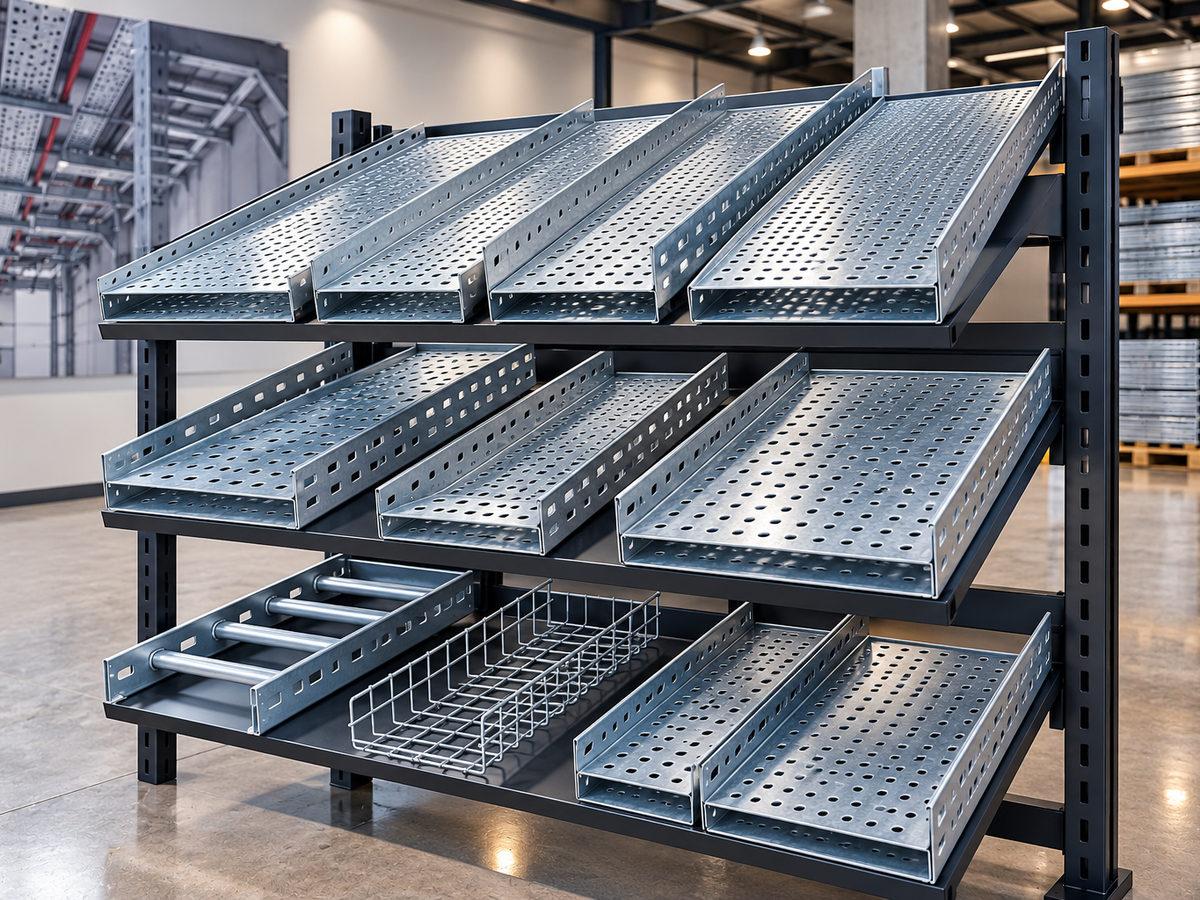
Perforated and ladder trays, made to your run
- Type
- Perforated or ladder
- Finish
- Pre-galvanised or coated
- Lengths
- Cut to your run
The product
What it is, and when it earns its place
Loose cable tied to a beam is a maintenance problem waiting to happen. A cable tray gives the run a defined path, keeps bend radii sane, holds cables clear of the structure, and means the next person who has to trace a fault can actually follow the route.
Perforated trays suit control and data cabling where cables are lighter and ventilation matters. Ladder trays suit heavier power cable over longer spans, where the rungs carry the weight and give obvious tie-off points. Ladder tray is supplied plain or pre-galvanised.
The straight lengths are the easy part. What decides whether a run goes up cleanly is the fittings — the elbows, tees, reducers and covers — and whether the tray was sized with room left over for the circuits nobody has asked for yet.
What we need to quote it
- Total run length, and the number of bends and junctions
- Tray width and depth, or the cable bundle it has to carry
- Perforated or ladder type
- Whether the run is indoors, outdoors or in a damp area
- Whether covers are needed
Where it is used
Where this one usually goes
Commercial buildings
Cable routed above false ceilings and along service corridors, kept accessible for later work.
Factory and plant areas
Power and control cable carried across spans on ladder tray, clear of the process floor.
Retail and office fit-outs
Data and lighting cable routed on perforated tray during a fit-out rather than clipped loose.
Options
The decisions you get to make
- 01
Perforated or ladder type
Perforated for lighter control and data runs, ladder for heavier power cable over longer spans.
- 02
Width and depth
Sized to the cable bundle you are carrying, with room to add circuits later.
- 03
Finish
Pre-galvanised for damp and outdoor runs, or powder coated to match a fit-out.
- 04
Bends and fittings
Elbows, tees, reducers and covers made to match the sections.
How it is supplied
How it reaches you
None of these are fixed catalogue values. Sizes, loading and lead time are settled against your particular job and written onto the quotation.
| Fabrication | Made at our own plant in Kanpur |
|---|---|
| Sizing | Made to order against your measurements |
| Loading | Confirmed per shelf at quotation stage |
| Lead time | Confirmed with your quotation |
| Installation | Delivered and fitted by our team |
Related products
Questions
Cable Trays: common questions
What is the difference between perforated and ladder tray?
Perforated tray has a solid base punched with holes and suits lighter control and data cabling. Ladder tray is a pair of side rails with rungs across them, and suits heavier power cable over longer unsupported spans.
Do you supply bends and fittings as well as straight lengths?
Yes. Elbows, tees, reducers and covers are made to match the sections so the run goes together on site.
What size tray do I need?
It follows from the cable bundle. Tell us what you are carrying and we will size the tray with room left to add circuits later rather than filling it at first fit.
Pre-galvanised or powder coated?
Pre-galvanised is the usual choice where damp is the concern, because the zinc goes on before the section is formed and covers the whole surface. Powder coating is chosen where the run is visible and has to match the rest of a fit-out.
Also worth seeing
Ordered alongside this, usually
Send us your shop measurements.
A photograph of the wall or the floor, and rough sizes. That is all we need to give you a price.